

Quick answer
Swiss trains run continuously from 00:00 to 23:59 daily, with most intercity routes operating on regular interval timetables—typically every 30 or 60 minutes. Journey times between major cities range from 60 minutes (Zurich to Bern) to three hours (Geneva to St. Moritz), and the SBB timetable integrates all operators so connections are coordinated. Real-time schedules are available at stations, via the SBB Mobile app, and online at sbb.ch.
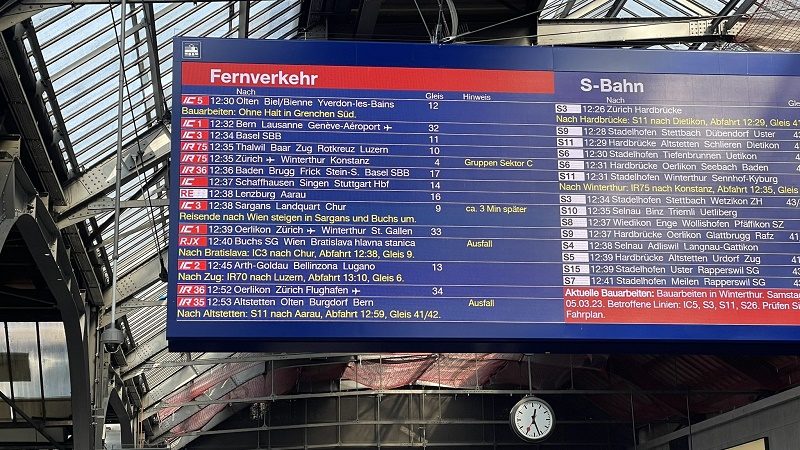
Switzerland's railway network carries over 1.3 million passengers daily on a timetable structured around the Taktfahrplan—an interval-based scheduling system that repeats every hour. Trains on major routes depart at the same minute past each hour, creating predictable connections at hub stations like Bern, Zurich HB, and Basel SBB. This rhythmic cadence means that a traveler missing the 08:32 departure can rely on the 09:32 service following the identical route. Journey durations reflect Switzerland's geography and engineering. The Zurich–Bern corridor takes one hour on direct InterCity services, while the Glacier Express from Zermatt to St. Moritz spans eight hours across 291 bridges and 91 tunnels. Regional trains serving mountain resorts operate on seasonal intensified schedules—summer and winter timetables add departures to match tourist demand, and some alpine routes close entirely during shoulder seasons. The SBB timetable at sbb.ch displays all services across the integrated network, including narrow-gauge operators like the Matterhorn Gotthard Bahn and private lines covered by Swiss Travel Pass validity. Connection times at interchange stations are built into the national timetable. Standard transfer windows range from four to seven minutes, sufficient because Swiss platforms are numbered clearly and trains arrive on schedule 93 percent of the time. Travelers checking swiss train travel times should note that the schedule distinguishes between direct services and routes requiring changes—an icon in the timetable indicates each transfer point. Seat reservations are not required on domestic trains, but purchasing tickets before boarding avoids the surcharge applied to on-board sales. The SBB Mobile app and station departure boards display real-time updates, platform assignments, and delay information. Trains are identified by category—InterCity (IC), InterRegio (IR), RegioExpress (RE), and Regio (R)—with journey times increasing as the service type includes more stops. Early morning departures between 06:00 and 09:00 offer the most seating availability and the least crowding, particularly on commuter routes into Zurich and Geneva. For travelers planning multi-leg itineraries, the online journey planner calculates total travel time including connections, and indicates whether a given routing allows sufficient margin for transfers.
“Switzerland's Taktfahrplan ensures that trains on major routes depart at the same minute past each hour, creating a predictable rhythm across the entire network.”
How to Plan Swiss Train Travel Times and Purchase Tickets
Planning Swiss train travel requires checking real-time schedules and purchasing tickets through SBB's digital platforms. The entire process typically takes 5–10 minutes from route search to confirmed booking.
Download the SBB Mobile app or visit sbb.ch
Install the official SBB Mobile app (iOS/Android) or navigate to sbb.ch in your browser. Many travelers mistakenly use third-party apps that lack real-time delay updates and integrated ticket purchasing.
Enter your departure and arrival stations
Type your origin and destination into the journey planner, then select your preferred travel date and time. The system defaults to "departure at" rather than "arrival by"—toggle this if you need to reach your destination by a specific time.
Review the schedule and connection options
Compare direct routes versus those requiring transfers, noting platform numbers and transfer times. Connections with less than 3 minutes between trains are flagged as tight—the system accounts for walking distances between platforms but not unexpected delays.
Select your ticket type and passenger details
Choose between single journey, return, or multi-day travel options, then enter passenger age categories (adult, child, senior). Half-Fare Card holders must select this discount before payment or the system charges full price with no retroactive refunds.
Complete payment and save your digital ticket
Pay via credit card, PostFinance, or Twint, then screenshot or save the QR code ticket to your app's wallet. Conductors scan this code directly—paper printouts from screenshots are not accepted as valid proof of purchase.
Daily Availability of Swiss Train Travel Times
The Swiss rail network operates consistently to support travel across the country at all times. Services are available daily, ensuring continuous connectivity for passengers throughout the week.
| Monday | 00:00–23:59 | |
|---|---|---|
| Tuesday | 00:00–23:59 | |
| Wednesday | 00:00–23:59 | |
| Thursday | 00:00–23:59 | |
| Friday | 00:00–23:59 | |
| Saturday | 00:00–23:59 | |
| Sunday | 00:00–23:59 |
Understanding Costs for Swiss Train Travel Times
Access to the Swiss public transport network requires a valid ticket, with costs determined by the specific journey distance and selected travel class. Entry to use the system is not a flat fee but depends on your itinerary.
A typical adult pays a fare calculated by their specific route, which changes based on the distance traveled and class of service.
Best Time to Optimize Swiss Train Travel Times
The best arrival window for Swiss train travel is 06:00–09:00, as off-peak hours offer less crowded trains and more seating availability.
Weekday mornings
Minimal crowds—
Traveling between 06:00 and 09:00 helps avoid the primary commuter peaks. Early departures provide consistent access to seating across the network.
April and May
Moderate crowdsMild temperatures (8°C to 16°C)
These spring months precede the main summer tourist season. You can expect manageable passenger volumes and pleasant conditions for travel.
October and November
Moderate to low crowdsCooler temperatures (5°C to 14°C)
Late autumn offers a quiet period before winter sports enthusiasts arrive. Rail services operate with standard frequency during this transition.
Verdict: The best time to optimize your journey is Tuesday to Thursday between 06:00 and 09:00 during the months of April or October.
Essential Checklist for Swiss Train Travel Times
Prepare these essentials before traveling on Swiss trains to ensure smooth boarding and travel.
-
Download the SBB Mobile app — Access real-time schedules, platform changes, and digital tickets in one place.
-
Verify ticket validity before boarding — Tickets must be activated and validated to avoid fines during inspections.
-
Carry government-issued photo identification — Controllers may request ID to verify ticket holder identity, especially for discount cards.
-
Check connection times between trains — Swiss trains depart precisely on schedule—missing a connection requires rebooking.
-
Note platform numbers in advance — Platforms are confirmed shortly before departure and trains will not wait.
-
Keep tickets accessible during journey — Random ticket checks occur onboard—have physical or digital proof ready.
Check availability
Frequently asked questions about swiss train travel times
Everything you need to know about swiss train travel times